

Most AI projects that disappoint do not fail on the model. They fail on the data, the plumbing around the model and the cases nobody planned for. What the research says, and six conditions for an AI tool that people still use a year later.
The demo went well. On a sample of documents the model read the fields correctly, the forecast looked plausible, the room was convinced. Six months later the tool is barely used. The team has gone back to its spreadsheet, and nobody can say exactly when it stopped working.
This is not bad luck. It is one of the most studied patterns in applied AI, and the causes are well known. They have little to do with choosing the right model, and a lot to do with what surrounds it: the data it learns from and receives, the systems it plugs into, and what happens when it is not sure. This article goes through what the research says, then sets out the conditions we check before putting any model into production.
What the numbers say
Two recent studies give an order of magnitude.
In February 2025, Gartner published a survey of data management leaders: 63% of organisations either did not have, or were not sure they had, the right data management practices for AI. On that basis, Gartner predicted that through 2026, organisations will abandon 60% of AI projects that are not supported by AI-ready data. The prediction is about projects without ready data, not about all AI projects, and that is exactly the point.
In 2024, the research organisation RAND interviewed 65 experienced data scientists and engineers about why AI projects fail. Its report notes that, by some estimates, more than 80% of AI projects fail, about twice the rate of IT projects that do not involve AI. Among the root causes it identifies: the problem to solve is misunderstood or poorly communicated; the organisation lacks the data needed to train an effective model; the team focuses on the latest technology rather than on a real problem for its users; and the technology is applied to problems too difficult for it.
Read together, these findings say the same thing. The model is rarely the weak link. The problem definition and the data are.
The model is the small part
In 2015, a team of Google engineers led by D. Sculley published a paper at the NeurIPS conference titled Hidden Technical Debt in Machine Learning Systems. Its best-known figure has been reproduced many times, including in Google Cloud's own guide to running models in production.
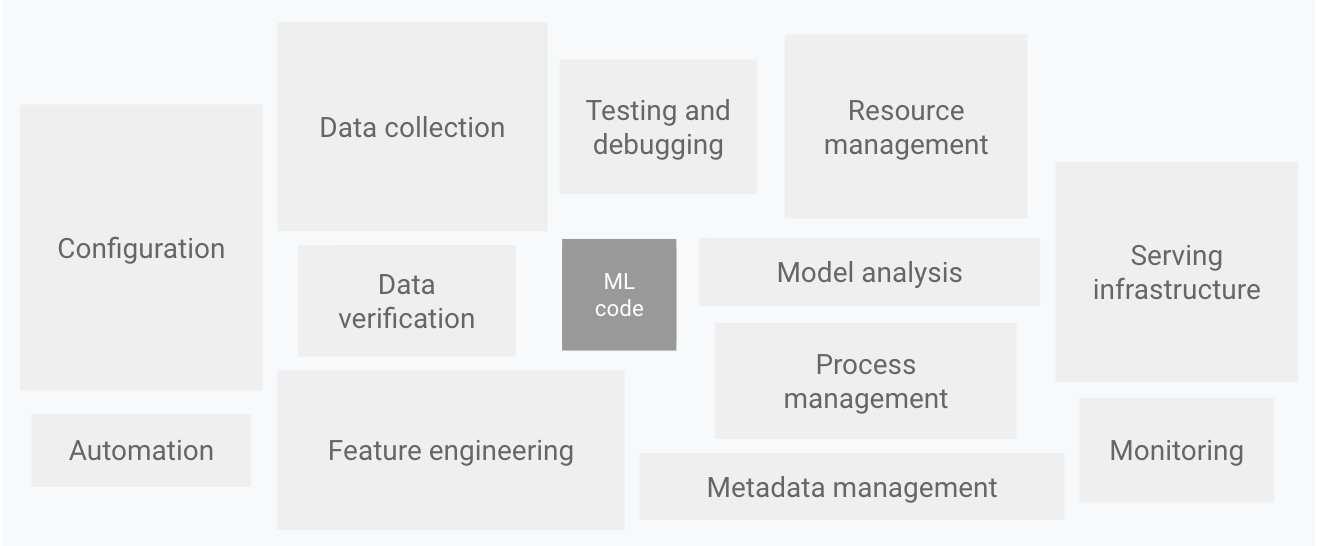
The small dark box in the middle is the model. Everything else is what a demo does not need and a production tool cannot do without: collecting the data every day, checking it, turning it into the inputs the model expects, serving the result to the right system, monitoring what happens, and doing all of it again when something changes. A demo can skip every one of those boxes. That is why it looks fast and cheap, and why it says almost nothing about the cost of the real tool.
Google's guide describes the most common starting point plainly: a manual process, in which data scientists build a model, hand it over, and it is rarely retrained. It also warns that models often break once deployed, because they do not adapt to changes in the environment or in the data that describes it.
Data problems arrive late, and they compound
In 2021, Nithya Sambasivan and her co-authors at Google Research interviewed 53 AI practitioners working on high-stakes projects in India, in East and West African countries and in the United States. They gave a name to what they saw: data cascades, chains of events caused by data problems that compound downstream. They report a 92% prevalence among the practitioners they interviewed.
The authors describe these cascades as pervasive, invisible, delayed and often avoidable. Delayed is the dangerous part. A problem in how data is collected or labelled at the start of a project may only show up months later, once the model is in production, when it is most expensive to fix. The paper's title quotes one of the interviewees and sums up the cause: everyone wants to do the model work, not the data work.
For a company, the practical translation is simple. The checks on the data must run before the model is trained, and keep running every day after it is deployed. A model trained on customer records full of duplicates learns from duplicates. A model fed invoices whose amounts are entered differently by two teams learns that confusion.
A person for the doubtful cases
No model is right every time. The useful question is not "how accurate is it?" but "what happens when it is unsure?"
The answer has a long history. In 1970, C. K. Chow published a paper in the IEEE Transactions on Information Theory on what he called the reject option: a classifier that can decline to decide when its confidence is too low, and leave the case to someone else. He described the trade-off between the share of cases rejected and the error rate on the cases accepted: rejecting more cases lowers the error on the rest. Later work, for example by Yonatan Geifman and Ran El-Yaniv in 2017, applied the same idea to modern deep learning models, framing it as a choice between coverage, the share of cases the model handles, and risk, the error rate on those cases.
In practice, this gives a tool that people can trust: above a confidence threshold, the case is processed automatically; below it, it goes to a person with the reason for doubt. The threshold is a business decision, not a technical one, because it sets how much work stays manual and how many errors are acceptable. Our article on after-sales request triage shows how to set it on real data.
Six conditions for everyday use
From these findings we keep six conditions. A demo usually meets the first two. A tool that is still used a year later meets all six.
| What it takes | A demowhat you see in a meeting | Everyday usewhat we deliver |
|---|---|---|
| A quantified goalWhat the tool should save: time, errors avoided, dirhams. | yes | yes |
| Data availableReal examples, within reach, that look like your business. | yes | yes |
| Checked dataDuplicates and empty fields found and fixed before starting. | no | yes |
| Plugged into your toolsThe result lands in the ERP, the CRM or the team's work list. | no | yes |
| A person for doubtful casesWhen the tool isn't sure, it says so and hands over. | no | yes |
| A monthly checkWe check it isn't getting things wrong more often, and fix it. | no | yes |
A demo usually covers 2 of the 6. We deliver all 6.
The four conditions a demo skips are the ones this article has described: data checked before training and on every new batch, a result that lands where the team already works, a confidence threshold with a review queue, and a monthly check of the share processed automatically and of the errors. None of these conditions is about the model itself. All of them can be checked before a single line of model code is written.
Where to start
- Write the goal as a number, with the person who will judge it.
- Collect a few hundred real examples and measure their quality before anything else.
- Decide where the result must land and who handles the doubtful cases.
- Only then compare models, on your data, with the threshold that fits your tolerance for errors.
This is how we approach production AI on ready data. If you do not yet know whether your data can support a use case, our data platform assessment answers that question in two to three weeks.
Sources
- Gartner, "Lack of AI-Ready Data Puts AI Projects at Risk", press release, 26 February 2025. gartner.com.
- James Ryseff, Brandon F. De Bruhl and Sydne J. Newberry, The Root Causes of Failure for Artificial Intelligence Projects and How They Can Succeed, RAND Corporation, 2024. rand.org.
- D. Sculley et al., "Hidden Technical Debt in Machine Learning Systems", Advances in Neural Information Processing Systems 28 (NeurIPS 2015). proceedings.neurips.cc.
- Google Cloud Architecture Center, "MLOps: Continuous delivery and automation pipelines in machine learning", last updated 28 August 2024, CC BY 4.0. docs.cloud.google.com.
- Nithya Sambasivan et al., "Everyone wants to do the model work, not the data work: Data Cascades in High-Stakes AI", Proceedings of CHI 2021, ACM. research.google.
- C. K. Chow, "On optimum recognition error and reject tradeoff", IEEE Transactions on Information Theory, vol. 16, no. 1, 1970, pp. 41-46.
- Yonatan Geifman and Ran El-Yaniv, "Selective Classification for Deep Neural Networks", Advances in Neural Information Processing Systems 30 (NeurIPS 2017). arxiv.org.